Friday, January 25, 2019

Passing of SOA member Pete Buscetto

SOA President Rick Estes announced today the “sad news” of the passing of former SOA Treasurer Pete Buscetto, 71. Pete passed away in his bed at home January 24 in Summerville, S.C., outside Charleston, said his son Chris Buscetto.
Rick Estes said, “It is my sad duty to report the passing of Pete Buscetto earlier today. Pete's many years of service to the SOA made him a very close friend to so many of us and will be greatly missed by all. The family will gather in the next day or two and make decisions regarding services. I told his son Chris how much he will be missed and that the SOA stood by to help anyway we can.”
Pete was appointed treasurer of the SOA in 2011 by the SOA Board of Directors to a three-year term in office. He was elected as treasurer in 2014 and again in 2017, but due to health issues was compelled to resign from his elected position during the summer of 2018. He joined the SOA in November 2000. He ran for director of the SOA in the early 2000 years and served on the SOA membership and by-laws committees working with then chairmen Ray Calafell and Ty Furbish.
Past SOA President John S. Meyer said, “In 2011, when the SOA board asked him to serve as treasurer, Pete stepped up to the plate and did all that we asked of him and more. He was a major asset to the SOA board and the SOA membership over the years. During my three-year term in office, Pete spent several hundred hours of his own time working to improve transparency of SOA financial reports as well as working with SOA tech staff improving on-line visibility and services for SOA members.”
SOA Membership Chairman Ray Frovarp said, “Pete was instrumental in developing the SOA website to include the ability to pay dues, apply for membership online and register for the annual reunion.
He was also instrumental in starting the annual CCS Southern Brotherhood Breakfast,” which began in 2012, working with former CCS commanding officer Col. Fred Lindsey, which brought together CCS recon men with all of the aviation units that served SOG recon teams running missions into Cambodia.
Meyer added, “In reflection, Pete said the period of his life that he was most proud of was serving as a SOG recon man, a Green Beret at CCS with RT Plane, at CCC and later trained SOG teams at Camp Long Thanh – the SOG training facility. He was the COO and president of CompUSA East, during a period of time that company grew to over $2 billion in revenues in 1992. He formed other companies, but his days in SOG were the highlight of his life, after marrying the love of his life Terry. In fact, he said that he often applied lessons learned from his recon days to business practices.”
SOA member Ben Lyons was CCS Recon team leader, One-Zero on RT Plane with Pete in 1971. “We ran six or seven missions together. He was real good in the jungle. On top of that, he was a good man and superb team mate. No ‘BS’ and no ‘Why this/why that/”crapopla with him unless he had a point to make and it was a good one. I never got the same questions twice from him and he always learned the first time. Can’t ask for much more out of a recon man...I’m real sorry to hear that he’s gone.”
Peter James Buscetto, was born June 14, 1947 to a career Air Force father, Bruce R. Buscetto. Being a military brat, Pete spent some of his childhood overseas, to include attending Ramsey High School in Aguadilla, Puerto Rico. Pete played football in high school, both as team quarterback and linebacker. He often said he enjoyed playing linebacker more than quarterback because as a linebacker his job was “to mess with the other team’s offense, I loved doing that.” During that time he became an accomplished martial arts student. He continued his education by attending Chowan College, Murfreesboro, NC, earning a Business degree (1964-1966). Pete enjoyed spending time in the woods of North Carolina, which he said helped him to be a good recon man moving through the jungle on missions from CCS and CCC.
Pete joined the Army in 1968 and served with Command and Control South (CCS), MACV-SOG 1970-1971 as a member of Recon Team (RT) Plane. In 1971 Pete was sent from CCS to CCC, and then To Camp Long Thanh to work as an instructor. Pete left Vietnam in Oct. 1971.
After his return from Vietnam, Pete married Theresa (Daiuto) on 18 Nov 1972. They enjoyed 46 years of marriage and the union produced two children, Christopher Buscetto, and Stacey (Buscetto) Wettermann.
Pete was preceded in death by his step-mother, Ruth Adelaide (Crowell) Buscetto. He is survived by his father, Bruce R. Buscetto; wife Terry Buscetto; son Christopher and daughter Stacey Wettermann; sisters JoAnn Vergnolle, Deirdre M Buscetto, Nancy B Burns and brother Bruce Greg Buscetto.
In 2001, commenting on being a recon man with MACV-SOG, Pete wrote: “Only three things counted in those days: did the man pull his missions, was he any good in the woods, and would you go to the bush with him. These standards, once meet, formed a bond among us that will last a life time.”

Thursday, January 24, 2019

On January 24, 1964 the Military Assistance Command Vietnam, Studies and Observation Group (MACV-SOG) was established.

On January 24, 1964 the Military Assistance Command Vietnam, Studies and Observation Group (MACV-SOG) was established.

MACV-SOG was an unconventional warfare task force engaged in highly classified operations throughout Southeast Asia. The U.S. Army's Special Forces (Green Berets), Air Force Combat Controllers, Navy SEALs and other units channeled personnel into MACV-SOG through Special Operations Augmentation (SOA), which provided their "cover" while under secret orders to MACV-SOG. The teams performed deep penetration missions of strategic reconnaissance and interdiction which were called, depending on the time frame, "Shining Brass" or "Prairie Fire" missions. By 1968, 327 missions had been conducted by reconnaissance teams into Laos and Cambodia. About 2,000 Americans served in SOG between 1964 and 1972. More than 300 of them died. In the late 1990s the story of MACV-SOG was finally declassified.

MACV-SOG headquarters was located in Saigon, Vietnam. Its ground operation personnel were stationed in Forward Operating Bases located throughout the country. Eventually three field Command and Control sub-headquarters were established - North (CCN), Central (CCC) and South (CCS).
Before 1962, the US military advisory effort in Việt Nam was co-ordinated by MAAG, which initially occupied the former SAMIPIC villa at 606 Trần Hưng Đạo in District 5. In February 1962, following the arrival of the first US Army aviation units, MAAG became part of the Military Assistance Command Việt Nam (MACV), which was set up to provide a more integrated command structure with full responsibility for all US military activities and operations in Viet Nam. MAAG survived until May 1964, when its functions were fully integrated into MACV. In May 1962.

When MACV relocated to larger premises, the villa at 606 Trần Hưng Đạo became known as MACV II. Then in 1966, following the transfer of MACV operations to Tân Sơn Nhất Air Base, it was vacated by the Americans and became the headquarters of Republic of Korea Forces Vietnam, which remained there until the signing of the Paris Peace Accords in 1973. Today, 606 Trần Hưng Đạo is home to a number of local businesses, but the old villa is currently under threat of redevelopment.

The second MACV headquarters in Saigon – an unassuming three-storey apartment building at 137 Pasteur in District 3 – has an interesting history. Before being taken over by the US military in May 1962, it served from 1955 to 1959 as the headquarters of the Michigan State University Group (MSUG), which was controversially engaged to advise President Ngô Đình Diệm on the reorganisation of his feared secret police. By 1966, MACV had outgrown this building too, so on 2 July 1966 it was relocated to the new purpose-built “Pentagon East” complex, adjacent to Tân Sơn Nhất Air Base. Between 1966 and 1972, 137 Pasteur functioned as the 
headquarters of the MACV’s Studies and Observations Group (MACV-SOG), a special operations unit tasked with covert warfare operations. When the last active-service US military units departed in 1972, all MACV operations in the south, including MACV-SOG, were subsumed within the Defense Attaché’s Office (DAO), a branch of the US Embassy. In the following year all DAO operations were transferred to the “Pentagon East” complex and 137 Pasteur was returned to civilian use.

Nothing now remains of the huge “Pentagon East” complex, which was formerly situated on the east side of modern Trường Sơn boulevard (the Tân Sơn Nhất International Airport approach road), between the Cửu Long and Hồng Hà street junctions. In its place today stand the CT Plaza Tân Sơn Nhất shopping mall and cinema complex, and next to it a very large building site. 

However, on nearby Hồng Hà street, visitors can still see the former Dodge City Bachelor Enlisted Quarters (BEQ) and one surviving building of the MACV Annex, both currently used by the Southern Airport Services Company (SASCO).


Tuesday, January 22, 2019

Today we pause to remember SSG Rowland E “Butch” “Hoot” Gibson, KIA, January 22, 1967 while on a mission with Reconnaissance Team Indiana.

Today we pause to remember SSG Rowland E “Butch” “Hoot” Gibson, KIA, January 22, 1967 while on a mission with Reconnaissance Team Indiana. SSG Gibson was 22 years old and joined the Army in June 1962, finished signal school as the top man in the class and attended medic training at Fort Sam Houston, Texas. He also received weapons training and was Ranger qualified. He arrived in Vietnam in April 1966, two years after joining the Special Forces.
Few specific details other than those in SSG Gibson’s Silver Star citation are known about the mission of RT Indiana. Silver Star Citation: The President of the United States of America, authorized by Act of Congress July 9, 1918 (amended by an act of July 25, 1963), takes pride in presenting the Silver Star (Posthumously) to Sergeant Rowland Edward Gibson (ASN: RA-16736294), United States Army, for gallantry in action while engaged in military operations involving conflict with an armed hostile force while serving with Detachment A-352, 5th Special Forces Group (Airborne), 1st Special Forces, in the Republic of Vietnam. Sergeant Gibson distinguished himself by exceptionally valorous actions on 22 January 1967 while serving as a Special Forces advisor to a Vietnamese unit during a search and destroy mission. At the moment insurgents were sighted to the front of his unit, Sergeant Gibson organized his men to sweep into their positions. As his men approached a tree line, several Viet Cong companies, concealed and well-fortified, opened up with intense fire. While his men were pinned down, Sergeant Gibson maneuvered to the left with the intention of flanking the entrenched enemy. Determined to prevent his men from being surrounded and overrun, he crawled 40 meters toward the bunkers with bullets and shrapnel striking the ground all around him. During this selfless action, he was fatally wounded. Sergeant Gibson's gallantry in action was in keeping with the highest traditions of military service and reflects great credit upon himself, his unit, and the United States Army.
SSG Gibson was buried Riverview Cemetery, Clarksville, Tennessee. His friend Albert R. Forster shared these comments about SSG Gibson. A wonderful medic and human being who was taken from us much too soon.
Sgt. Gibson was our B team medic and went to Hiep Hoa in April 1966 to reopen the camp. He immediately started doing Medcaps for the local villages, and was highly respected by the local villagers. As the year progressed all of us left Hiep Hoa for other camps. Sgt. Gibson stayed because he had such a fondness for the locals and was having such a major impact on the local area. He was one of the finest men I served with. He respected the Vietnamese and served them and us with distinction. He was the one person I felt whose death could not be rationalized. He was one of the most dedicated, honest, moral, and humane men I ever had the pleasure to serve with.


Today we pause to remember SOG warriors SGT Frank A. Celano, SSG Kenneth Lovelace, and SGT Hugh D. Opperman and WO1 William Herman Seaborn, Jr. (240TH AHC), helicopter pilot, lost on January 22, 1971, when their helicopter was shot down while on a rescue mission.

Today we pause to remember SOG warriors SGT Frank A. Celano, SSG Kenneth Lovelace, and SGT Hugh D. Opperman and WO1 William Herman Seaborn, Jr. (240TH AHC), helicopter pilot, lost on January 22, 1971, when their helicopter was shot down while on a rescue mission.
The three SOG men were at the SOG training camp at Long Thanh in Bien Hoa province. SFC Celano and SGT Opperman were attending the 1-0 school and SSG Lovelace was an instructor at the school. They were all in the mess hall having lunch when the camp Sergeant Major entered and grabbed the eight men he found there. He said, "Get your shit. We're going in on a downed chopper. The bird is in-bound.
The downed helicopter was an observation chopper, a two-man Loach that had crashed and burned in dense growth thirty clicks from Long Thanh. Efforts were immediately instituted to rescue the crew: CW2 Rog Johnson, pilot; SGT Michael Harris Petty, observer; and SP4 Frederick Anthony Vigil, crew chief.
WO1 Seaborn was in the area flying on a training mission when the orders to help with the rescue effort were issued. He landed at Long Thanh and picked up the eight Special Forces men. They flew to the location of the wrecked Loach craft and lowered rolled aluminum ladders down both sides. The team was climbing down the ladders when a B-40 rocket hit the front of the chopper, taking out the pilot and flight controls. The chopper lifted rapidly, and then rolled to its side, flinging off the men who were clinging to the ladders. All died from the fall. Several who were in the chopper survived. The three crew from the crashed Loach did not survive, and all bodies were recovered along with a NVA body, along with his B-40 launcher and backpack.
SSG Kenneth Lovelace was an instructor at the Recon Team Leaders School, B-53, Long Than, Ops 38. SSG Lovelace was from Bellefontaine, Ohio and married. He was buried Highland Memorial Cemetery, West Liberty, Logan County, Ohio,
SGT Frank Anthony Celano, trainee at Recon Team Leaders School, was 21 years old and from Los Banos, California. He had a fiancée waiting for him back in San Diego. Frank was buried in Los Banos Cemetery, Los Banos, California.
SGT Hugh Daniel Opperman, trainee at Recon Team Leaders School was killed the day after his 21st birthday. Danny was buried at the National Memorial Cemetery of the Pacific, Honolulu, Hawaii.


Monday, January 21, 2019

1LT Joseph Slifka, who died January 21st, 1972 while a member of TF1AE. - Đoàn 1 Sở Liên Lạc

Today we pause to remember 1LT Joseph Slifka, who died January 21st, 1972 while a member of TF1AE. SSG Don F "Sluggo" Murphy tells the story of the loss of 1LT Slifka (originally printed in the November 1994 issue of The Green Beret).
"Those involved from CCN were RT Connecticut lead by Kevin “Snake” Smith, RT Habu the Bright Light Team, led by SGT Lemuel McGlothern, and the air assets from MLT-1 located in Phu Bai, RVN. The actions of both recon teams, the Navy UDT divers, and the combined air assets were instrumental in the success of this mission. I was the airborne controller (Covey Rider) flying out of MTL-1 at Phu Bai, and I worked the mission on both dates. I arrived on station to relieve another Covey, who had just extracted RT Connecticut from a hot LZ. I got a visual on the extraction package of slicks and guns. They were following the blue line east through a remote mountain pass near the Lao border. Knowing they were low on fuel, I instructed slick lead to follow us back to the launch site. After several moments I heard lead say, “Mayday! Mayday! Mayday, I’m going in!” We turned West just in time to see him crash land on a sandbar in the river. Aboard the aircraft was a crew of four, SSG Kevin “Snake” Smith, the One Zero, his One Two, 1Lt Slifka, and four CIDG team members.
Snake radioed that all was okay, the bird was shut down and the guns removed. Swiss seats were tied together, then Snake swam to the North bank and began ferrying the rest across using the chopper as an anchor point. While this was taking place, I had to send the slicks and guns home because they were low on fuel. I ordered up TAC air, a set of Gunfighters (F-4s) that were scrambled from Da Nang with an ETA of ten. Also, two Navy fighters were diverted from the trail with residual 20mm. Our launch sergeant, MSG Chuck Dover, had been monitoring our situation and said help was on the way.
Before the transfer to the North bank could be completed, the team began to take small arms fire from the wood-line and was returning fire. We could see the muzzle flashes so we laid down a mark and ran in the Navy jets expending their ordnance. Our Gunfighters arrived with a TIC lineup on board of napalm, CBU, and frag bomb with fuse extenders. The strike was laid in and suppressed the enemy fire.
Snake called that he had an American missing and when last seen the American was covering the team from the sandbar. He team began ground search of the river bank, and we low-leveled to assist. The river had a sand bottom and was crystal clear. I spotted 1Lt Slifka’s body about two hundred meters downstream, in a deep pool at the edge of a waterfall.

The extraction package arrived and the team was extracted with the aircrew. CPT Walter S. Mullen, our assistant launch officer, hovered above the pool in the chase bird and attempted to recover the body with a grappling hook. He was not successful, as the body was hopelessly snagged in the branches of a submerged tree. Our covering guns reported a village hidden under the jungle canopy, and the Cobras placed fire on it with rockets and 40mm.
I received a call that Snake was inbound with swimming gear and ropes to attempt a recovery. This attempt also failed because the river was too swift; without scuba gear and weight belts it was an impossible task. By this time the crashed Huey had settled onto it’s right side of the sandbar, but was in no danger of being swept into the current. Snake requested and received permission to make a recovery attempt on the following day. Preplanned air was ordered and two Navy UDT divers were sent up from Da Nang. If the recovery went smoothly the RT would do a BDA of the village, which was to be hit with a devastating air strike. Also, the Bright Light team would be used to cover from the South bank. Additional slicks and guns would sit on strip alert with a round-robin turn around for constant air cover from insertion until extraction.
Our intelligence sergeant, SFC Kenny Anderson, provided the intel pictures I had taken of the target. He suspected the hostiles in the target area to be part of one of the NVA Food Production and Transportation Battalions known to work the area. MSG Chuck Dover briefed all concerned on how the operation would work. Timing and start-up time would begin when Covey reported the target clear of ground fog. We launched our 0-2 at about 0900 hours on 21 January and climbed to 12,000 feet. We began our normal sneak and peek through the clouds to observe the target which was socked in. We busied ourselves by checking known or suspected AAA and SAM sites on both sides of the fence; we also noted likely avenues of approach to the target area. By 1000 hours the fog had dissipated, and I reported this to home plate. At that time Chuck gave the order to play ball.
The teams launched and our first set of Gunfighters arrived above us. Our set of Sandys had just left NKP and were climbing to altitude. With all assets on station we went down to lay in the mark on the village. Our fast movers rolled in and each dropped a large WP bomb, creating a roaring inferno. Next they dropped combination of delays and daisy cutters. Our capping A1Es requested to dump that nape to increase playtime, and we had them hit the eastern and western edges of the village. When they returned to cap they reported over four hours playtime left. At eight minutes out we released our second set of Gunfighters to prep both Las with napalm and 500 pound daisy cutters. Both teams hit their LZs at the same time and had them secured in short order. We put both sets of Cobras in a racetrack pattern to prevent any reinforcements from entering the area and to suppress any AA threat. I called ABCCC (Hillsboro) and reported the target box hot. Then Snake reported that he was on the sandbar and he had divers in the water. Using the Huey as an anchor point, they belayed the divers down stream. My greatest worry at that time was that of the belaying team being hit without safety ropes the divers would be lost over the falls and onto the rocks below. After what seemed like forever, the Snake reported that the Lieutenant’s body and the divers were recovered. Both divers were completely exhausted, and we sent in the chasse bird to pick them up.
With the recovery completed, we initiated the BDA when our fresh Cobras came on station. We sent both sets of guns to orbit on the flanks and sent in the Sandys to bomb and strafe the front of the RT. The team could not get into the village due to the fires and secondary explosions. They did get some good intel pictures and examined some fighting positions. In addition to some enemy equipment, they recovered quite a few farming implements. Both RTs were extracted without further incident and the target box was reported cold.
My last act was to order the guns to destroy the drowned Huey, and we watched as some of the wreckage slipped over the falls. The post mortem examination revealed that Joe drowned; we understand his family had a hard time dealing with this because he was an Olympic class swimmer. We will never know exactly how this tragic accident happened, but Kevin and myself have tried to describe the incident as accurately as possible after 22 years."
 1st. Lt Joseph J. Slifka, Jr was from Missoula, Montana, 23 years old and married. He is honored on Panel 2W, Row 99 of the Vietnam Veterans Memorial and is buried at Arlington National Cemetery.

Wednesday, January 16, 2019

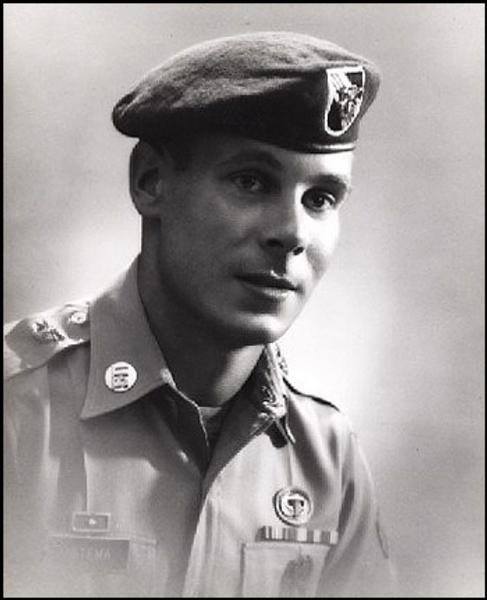
SGT Gordon D. Yntema, with 5th Special Forces Group (Airborne) in Vietnam,

On this day 51 years ago SGT Gordon D. Yntema, while serving with 5th Special Forces Group (Airborne) in Vietnam, distinguished himself by conspicuous gallantry and intrepidity at the risk of life above and beyond the call of duty while advising civilian irregulars from Camp Cai Cai and repelling a Viet Cong attack during their attempts to overrun his position. SGT Yntema was awarded the Medal of Honor in 1969 for these actions. Visit the following link to read SGT Yntema’s Medal of Honor citation: http://www.cmohs.org/recipient-detail/3454/yntema-gordon-douglas.php

YNTEMA, GORDON DOUGLAS

Rank: Sergeant
Organization: U.S. Army
Company: Company D
Division: 5th Special Forces Group
Born: 26 June 1945, Bethesda, Md.
Departed: Yes
Entered Service At: Detroit, Mich.
G.O. Number:
Date of Issue:  
Accredited To:
Place / Date: Near Thong Binh, Republic of Vietnam, 16-18 January 1968
YNTEMA, GORDON DOUGLAS Photo
Citation
For conspicuous gallantry and intrepidity in action at the risk of his life and above and beyond the call of duty. Sgt. Yntema, U.S. Army, distinguished himself on 16-18 January 1968, while advising civilian irregulars from Camp Cai Cai. Sergeant Yntema accompanied two platoons to a blocking position east of the Village of Thong Binh. They became heavily engaged in a fire fight with the Viet Cong. Assuming control of the force when the Vietnamese commander was seriously wounded, Sergeant Yntema advanced his troops to within 50 meters of the enemy bunkers. After a fierce fire fight, Sergeant Yntema withdrew his men to a trench which offered them protection while still allowing them to perform their blocking mission. Under the cover of machine gun fire, a company of Viet Cong maneuvered into a position effectively surrounding Yntema's platoons on three sides. A dwindling ammunition supply, coupled with a Viet Cong mortar barrage which inflicted heavy losses on the exposed position, prompted many of the South Vietnamese troops to withdraw. Seriously wounded and ordered to withdraw himself, Sergeant Yntema refused to leave his fallen comrades. Under withering small arms and machine gun fire, he carried the wounded Vietnamese commander and a mortally wounded American Special Forces advisor to a small gully 50 meters away to shield them from the enemy fire. Sergeant Yntema continued to repulse the attacking Viet Cong during their attempts to overrun his position until, out of ammunition and surrounded, he was offered the opportunity to surrender. Refusing, Sergeant Yntema stood his ground, using his rifle as a club to fight the approximately fifteen Viet Cong attempting his capture. His resistance was so fierce that the Viet Cong were forced to shoot him in order to overcome him.

Thursday, January 10, 2019

Thiếu Tướng E. John Deedrick Jr. Chỉ Huy Trưởng Liên Đoàn 1 LLDB trao quốc kỳ cho gia đình Đại Úy Andrew Ross

Maj. Gen. E. John Deedrick Jr., commanding general of 1st Special Forces Command, presents a U.S. flag to the family of Capt. Andrew Ross in Section 60 of Arlington National Cemetery, Arlington, Virginia, Jan. 8, 2019. (U.S. Army photo by Spc. Lane Hiser).

Credit: The 3rd Inf. Reg. The Old Guard.